Creating the first set of eLearning Courses is the biggest challenges for L&D Teams. With PlayAblo LMS™ you can convert your existing PPTs into beautiful eLearning courses in a single click! Track and measure the workforce performance using our best in class visual dashboards. Ask for a demo to see if PlayAblo might be right for your workforce.
There are many different eLearning models available, but that doesn’t imply they’re all made equal or can all be used to develop an eLearning course for the same organization or business. On the other hand, the Four-Door eLearning Model provides a substantial number of advantages. It enables instructional designers to rapidly and accurately build attractive and successful eLearning courses, and SMEs and others can also use it with no formal training as instructional designers.
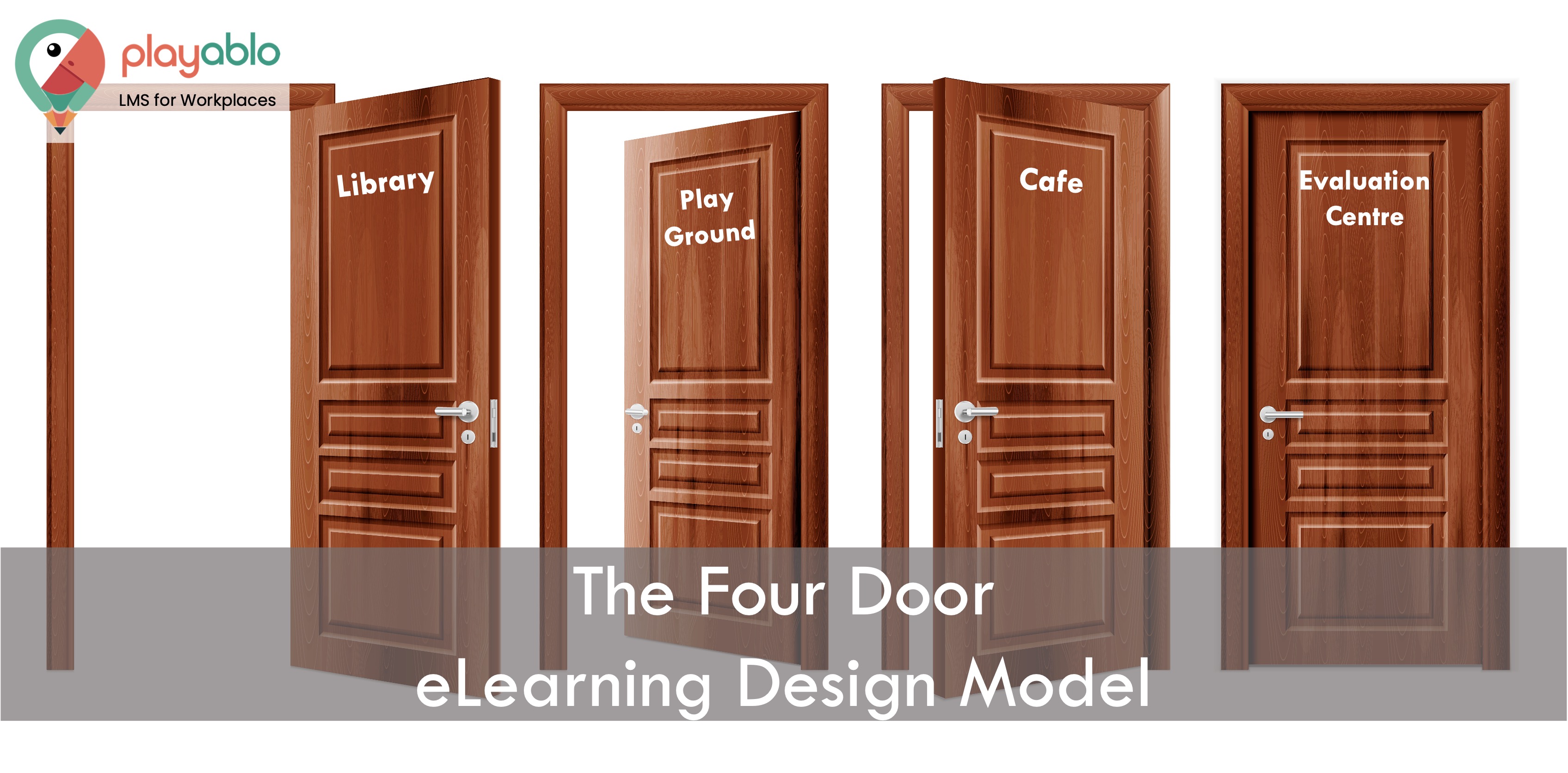
The four-door eLearning design paradigm, developed by Dr. Sivasailam Thiagarajan (Thiagi), is an instructional design approach that places learners in charge of their learning. It appears to be straightforward. Yes, it is. Four doors link to each other. The design of each one is to resemble four critical aspects of the learning environment. And they’re all working for the same goal.
Table of Contents
The Four-Door eLearning Model: An Introduction
Thiagi was dissatisfied with how eLearning emphasized passive learning (where participants learned mostly through reading) interspersed with pointless multiple-choice exam items many years ago. Employees were thrilled since they could attend these classes on their own time, at a low cost, and without traveling. The issue was that these eLearning courses did not function when it came to mastering and applying new skills and knowledge.
Thiagi came sorted the learning activities into four categories. He compared these groups to chambers divided by four doors. Each space was connected to the others and adhered to a set of design guidelines:
The learner’s learning must be relevant to him or her.
Learning must be linked to a commercial goal.
What matters is the activity, not the content.
The students are free to set their own pace and sequence.
Don’t rely on technology just because it is convenient.
Thiagi’s four-door eLearning approach is appealing since it acknowledges the learning process that instructional designers go through when working on a project. And it’s applied to the students themselves. Learners have control over how they progress through the program, including which doors to open and when. As a result, they are more engaged with the material. As a result, knowledge intake and retention improve.
It’s a basic instructional design paradigm that allows training and non-training professionals to create eLearning programs that meet the demands of a wide range of learners rapidly and affordably.
So, what does each of these doors signify? Let’s have a look at what we’ve got.
As perMcKinsey, in the hybrid workplace model, 58 percent of executives report improvements in individual productivity, but an additional third say that productivity has not changed.
In arecent survey, it was found that 60 percent of respondents who perceived the performance-management system as fair also stated that it was effective.
Ongoing development discussions are a crucial way to truly listen to employees and put people back in the idea of “people development.” Based on McKinsey's research, of participants who said their organizations had effective performance-management systems, 71 percent stated that managers were trained in providing feedback and coaching. Indeed, much of the fairness of a performance-management process rests on managers’ ability to coach effectively.
Morgan Stanley announced the launch of the Institute for Inclusion’s (IFI) Equity in Education and Career Consortium. Through collaboration with partner organizations, this initiative will support high school and college students so they can achieve stronger career and financial outcomes. Funded by an initial commitment of $20 million, this initiative will help address systemic inequities in education and career outcomes for young adults from low-to-moderate income backgrounds with a focus on ethnically diverse students. Read more...
Building relationships can make you feel nervous, restless, and tense. This is especially true when you are starting a new job. For example, you may have questions. Luckily, there are many ways to build work allies without a lot of effort. Here are five of the best ways to make and cultivate allies at work.
With the gradual reopening of nations around the world, organizations have been evaluating post-pandemic working models and the physical return to work. The COVID-19 crisis forced many organizations, particularly those largely composed of knowledge workers, to shift to a remote model. As organizations adopt remote hybrid work, we see three risk areas that deserve careful attention.
PlayAblo LMS | Product News
PlayAblo™ LMS now offers Ready to Use Learning Courses
Building new courses from scratch is hard work. We know it. Which is why PlayAblo™ LMS now comes bundled with multiple soft skills courses like POSH Training, Effective Communication, Time Management etc. Reach out to us and see how you can get our soft skills training courses bundle for FREE!
Learn about: 1. Evolution of eLearning 2. Approach to selecting an LMS 3. Learning traits of your workforce today 4. Implementing, Boosting adoption and Ensuring success of your LMS Platform.

.png)


.jpeg)