Wouldn’t it be amazing if we could remember all that we learn for a longer time? Unfortunately, that’s a far-fetched dream for the majority of us. We usually end up forgetting most of the vital information we learn in a short while. If I had to ask you how often your workplace colleagues forget crucial details after a training session, I’m sure most of you would agree to my answer, “Quite frequently!”
We live in a world of information overload; we’re bombarded by60,000 piecesof information across multiple channels daily. Yet, the average human brain can retain600-800‘chunks’ of information at one time before it becomes too noisy and fatigued to store more information.
But why does that happen? Why do we remember the stark details of our favourite show’s character dialogues but tend to forget our neighbour’s name?
Simple, because our brain doesn’t consider it “important” enough. Fascinating, right? Our brain automatically categorises new work processes or steps to a new tool as unimportant but remembers which breed is your colleague’s dog you met 6 weeks ago, even though it’s quite the opposite in an absolute sense.
So, the question arises: how can we beat our brain to make the most of it? How can we remember and retain information for long periods? How can we win this fight against forgetfulness for better employee performance and productivity in organisations?
The secret lies in overcoming the “forgetting curve” to convince your mind to believe that absorbing new information is essential. But what exactly is this famous forgetting curve theory, and how can it help us combat forgetfulness?
Let us explore the nuances of our brain with a psychology expert’s well-known experiment.
Exploring the mind with Hermann Ebbinghaus’s ‘forgetting curve’ Theory
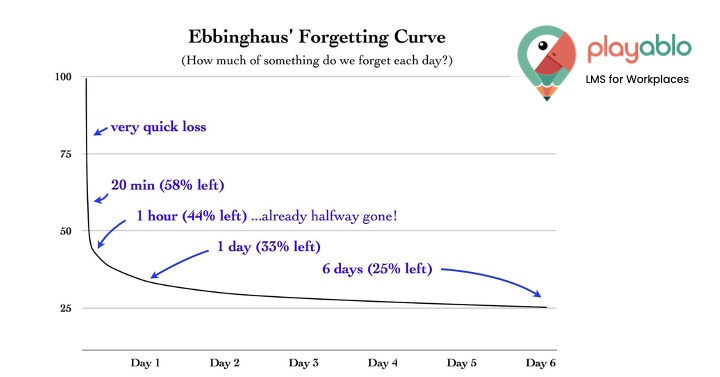
Hermann Ebbinghauspresented his forgetting curve formula more than a hundred years ago based on his self-psychological experiment. The theory states that we forget things because of the space in time between recent exposure to new information, how we review that information or practice it, and our learning mood. In addition, he argues that we tend to forget around 50% of what we had learned in a day or two and remember only 20% a month later.
So it is no surprise that many people struggle to learn things they need to know. And it becomes more difficult with every year that goes by as you grow old and your mind reaches its maximum potential.
One of the most popular tactics of fighting this “forgetting curve,” as suggested by various psychological experts around the globe, is through the microlearning process, aninnovative approachto tackle this forgetting curve.
Combating the Forgetting Curve with Microlearning
The forgetting curve is about more than just repeating the same thing over and over. You have to space out your revisions at regular intervals to allow your brain to reconstruct that memory.
Sowhat is microlearning? It’s quite simply a way of delivering information using different techniques to improve learning from immediate and short-term memory to long-term memory. It breaks down learning into...
Freelance and contract workers make up at least 35% of the workforce and are more interested (and accustomed to) online training [Source]
In 2020, 90% of companies used eLearning as a training tool. While this didn’t quite reach the percentage predicted in 2017 (an optimistic 98%), COVID-related remote work definitely pushed it close.[Source]
This survey asks executives about types of transformations (what types their companies had undertaken and why), goals for the transformation (what the goals were, how they were defined, and how successfully they were met), and implementation (how companies structured and carried out the transformation).
An organization’s health -- its ability to align around and achieve a strategic goal is critical for long-term performance. However, many leaders overlook organizational health because they lack a clear way to measure and improve it. McKinsey's quantitative diagnostics and proven recipes for success empower senior leaders to measure and achieve the organizational health required to sustain long-term performance.
It’s a new age for learning and development. Online content, MOOCs, collaboration tools, and social media now fuel a training model where employees own their skills and experts share knowledge freely. And this article addresses how you can use these trends to design a corporate training program
In a competitive external talent market, learning is vital to an organization’s ability to obtain needed skills. But to achieve the goal of lifelong learning, it must be embedded into not only the flow of work but the flow of life. Read how.
PlayAblo™ LMS | Product News
Convert PPTs to beautiful eLearning Courses in a Click!
One of the biggest challenges for the L&D Team, when deploying a new LMS, is how to create learning content. Building eLearning courses from scratch is an extensive and expensive process involving procuring additional eLearning course authoring tools. PlayAblo makes this a breeze. Its in-build CMS solution coverts your existing PPTs into eLearning courses in a single click!
Get PlayAblo's comprehensive eBook with in-depth articles and advisory on Implementing eLearning at the Workplace.
Learn about: 1. Evolution of eLearning 2. Approach to selecting an LMS 3. Learning traits of your workforce today 4. Implementing, Boosting adoption and Ensuring success of your LMS Platform.

.png)