Pull out the checklist you used the last time you evaluated an LMS. It probably covered the LMS capabilities everyone asked about: SCORM support, reporting, mobile access and maybe gamification.
Those still matter. But in the past year, the questions leaders ask about learning have changed. Employees now reach for AI before they reach for a course. Leadership wants to know whether people can do the job, not whether they clicked through a module. And training teams are expected to move at the speed of the business.
A checklist written for the old world will pick a platform for the old world. Below are seven LMS capabilities that weren’t on most RFPs a year ago, why each one now belongs on yours, and what to ask vendors when you evaluate them.
Table of Contents
What are LMS capabilities?
LMS capabilities are what a learning management system lets your organisation actually do: create and deliver training, assess people, track progress and report on results. Features are the individual tools. Capabilities are the outcomes those tools make possible.
Most platforms now cover the core LMS capabilities well:
- Course hosting and SCORM support
- Learning paths and assignments
- Assessments and certifications
- Reporting and completion tracking
- Mobile access
These are table stakes. The seven capabilities below are what separate a modern learning platform from a course library.
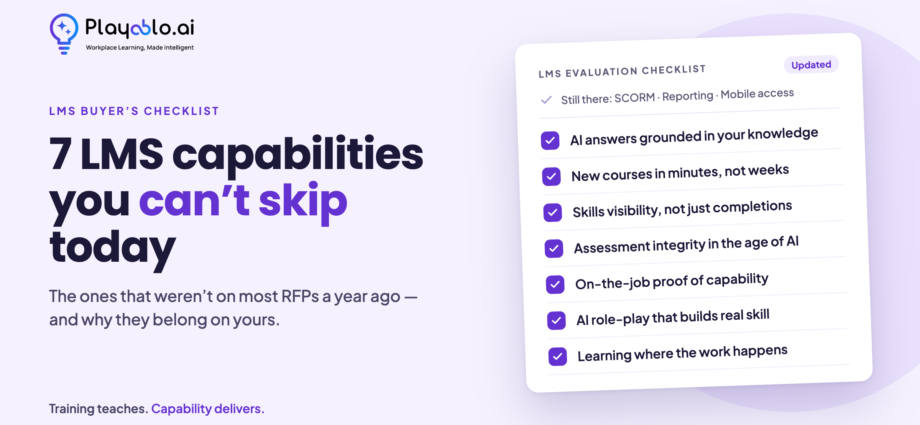
7 modern LMS capabilities your checklist now needs
1. AI answers grounded in your own knowledge
Your people are already asking AI for help. The question is whether they get a generic answer from the open internet or the right answer from your SOPs, policies and product documentation.
A modern learning platform should let employees ask questions in plain language and get answers drawn from your company’s own knowledge base. Good answers should also make it easy to see where they came from, so people can trust them and check them.
What to look for: answers scoped to your approved content, not the open web.
2. AI course creation: new courses in minutes, not weeks
For most L&D teams, the bottleneck has never been ideas. It’s production. A new process launches, and the training arrives a quarter later.
AI-assisted course creation changes that equation. Turning existing material, like a slide deck or a process document, into a structured course should take minutes. Your experts stay in control of accuracy; the platform handles the heavy lifting.
What to look for: the ability to start from content you already have, with your team reviewing and editing before anything goes live.
3. Skills visibility, not just completion reports
A completion report tells you who finished a course. It doesn’t tell you who can do the job.
Leaders now want to see capability: which skills a role needs, where each team stands against them, and where the gaps are. That requires a competency framework connected to assessments and real performance, not a spreadsheet maintained on the side.
What to look for: role-based skill frameworks, proficiency tracking, and a view leaders can act on.
4. Assessment integrity in the age of AI
An online quiz used to be a reasonable proxy for knowledge. Today, an AI assistant is one browser tab away.
If certifications and compliance sign-offs matter in your organisation, the assessments behind them need to hold up. That means thinking about proctoring and about assessment design that tests application, not recall.
What to look for: proctoring for high-stakes assessments, and question formats that are harder to shortcut.
5. On-the-job evaluation: proof of capability
Passing a test isn’t the same as performing on the shop floor, at the store counter or in front of a client.
The most reliable evidence of capability comes from the people who see the work: supervisors and managers. A modern platform should make it easy for them to observe, rate and give feedback on real tasks, and feed that back into each person’s skill profile.
What to look for: structured on-the-job evaluations and supervisor feedback, captured on mobile, in the flow of work.
6. AI role-play that builds real skill
Some skills only improve with practice: handling an upset customer, negotiating on price, giving difficult feedback. Most people get that practice for the first time in front of a real customer.
AI role-play gives them a safe place to rehearse. An AI coach plays the other side of a realistic sales or service conversation, and learners can practise as often as they need before the real moment.
What to look for: role-play practice built on your own scenarios, with feedback after every attempt.
7. Mobile-first learning that works where the work happens
A large share of the workforce doesn’t sit at a desk. Retail associates, factory teams, field sales and service staff learn on their phones, between tasks, sometimes without a reliable connection.
A platform designed for the desktop and adapted for mobile will always feel like a compromise to them.
What to look for: mobile-first design, offline access, and short formats that fit a shift.
LMS capabilities checklist: what to ask in your next demo
Use this table to score vendors side by side. Ask each one to show you the capability live, not just describe it on a slide.
| LMS capability | What to look for | Question to ask in the demo |
| AI answers grounded in your knowledge | Answers scoped to your approved content, with sources shown | “Show me an answer and where it came from. Can it answer from the open web?” |
| AI course creation | Start from existing slides or documents; your team reviews before publishing | “Turn this process document into a course while we watch.” |
| Skills visibility | Role-based skill frameworks, proficiency tracking, a leadership view | “Show me where one team stands against the skills its role needs.” |
| Assessment integrity | Proctoring for high-stakes tests; questions that test application | “How do you stop someone answering with an AI assistant in another tab?” |
| On-the-job proof | Supervisor evaluations and feedback captured on mobile | “How does a supervisor’s rating reach the employee’s skill profile?” |
| AI role-play | Practice built on your scenarios, feedback after every attempt | “Can we load our own sales or service scenario?” |
| Learning where work happens | Mobile-first design, offline access, short formats | “Show me the learner app on a phone with no connection.” |
The bigger shift: from courses to capability
Look at these seven LMS capabilities together and a pattern appears. None of them is about delivering more courses. They’re about connecting knowledge, skills, real-world performance and operations to a single question: can our people do what the business needs?
That’s the gap between a learning management system and what we call a Learning Operating System. Training teaches. Capability delivers.
Frequently asked questions about LMS capabilities
What are the most important LMS capabilities today?
The core LMS capabilities still matter: course delivery, SCORM support, assessments, reporting and mobile access. On top of those, buyers now look for AI answers grounded in company knowledge, AI course creation, skills visibility, assessment integrity, on-the-job evaluation, AI role-play and mobile-first, offline learning.
What is the difference between LMS features and LMS capabilities?
A feature is a specific tool, such as a quiz builder or a report. A capability is the outcome a set of features delivers, such as proving that an employee can do the job. Evaluating capabilities keeps the conversation on business results rather than feature counts.
Which LMS capabilities matter most for frontline teams?
For frontline and deskless teams, prioritise mobile-first design, offline access, short formats that fit a shift, and on-the-job evaluations that supervisors can complete on a phone. For customer-facing roles, AI role-play adds safe practice before real conversations.
How do I evaluate an LMS’s AI capabilities?
Ask to see them live. Check whether AI answers come only from your approved content and show their sources, whether your experts can review AI-generated courses before they go live, and whether role-play can use your own scenarios.Updating your checklist? See how PlayAblo.AI brings these seven LMS capabilities together in one platform. [Book a demo]